Loan Disbursement Reconciliation: Process and Best Practices
Every day, banks and financial institutions process hundreds of thousands of retail, consumption and corporate loans. Each one requires lenders to verify multiple documents, formulate loan agreements and then disburse funds to borrowers.
With high transaction volume comes the risk of amount mismatch or omissions in your lending data, which can impact your legitimacy among borrowers. Loan disbursement reconciliation thus becomes important not only to avoid such risks but also to fulfil your reporting requirements to higher authorities.
This article looks into what loan disbursement reconciliation is, its types, process, some best practices and how Osfin streamlines it for you.
What Is Loan Disbursement Reconciliation?
Loan disbursement reconciliation is the process where lenders, whether commercial banks or other financial institutions, match the disbursement data with their internal records. This would reconcile bank statements about the disbursed amount with borrower data, loan agreements and amortisation schedule and resolve any discrepancies that may have arisen.
This helps in ensuring that the right amount was sent to the right borrower while keeping banks and financial institutions compliant with their reporting requirements.
Types of Loan Disbursement Reconciliation
Since the conditions governing disbursement vary across different types of loans, it also ends up making loan disbursement reconciliation different for each type. These are
1. Full Disbursement
Once the borrower has completed the documentation, the lender disburses the whole loan at once to them.
2. Partial Disbursement
In partial disbursement, the funds are released to the borrower in stages whenever a predefined condition is fulfilled or a project phase is completed.
3. Instalment Disbursement
This involves the release of fixed portions of the loan to the borrower at scheduled intervals.
4. Direct disbursement
In some cases, a borrower gets a loan to pay a third party. In these cases, the lender makes direct disbursement where funds are remitted directly to these third parties, such as a vendor, service provider, contractor, etc.
5. Deferred Disbursement
Deferred payments refer to instances when the borrower has completed all the required documentation for the loan, but the funds are released to them on a future date as specified in the loan agreement.
What Gets Reconciled in Loan Disbursements?
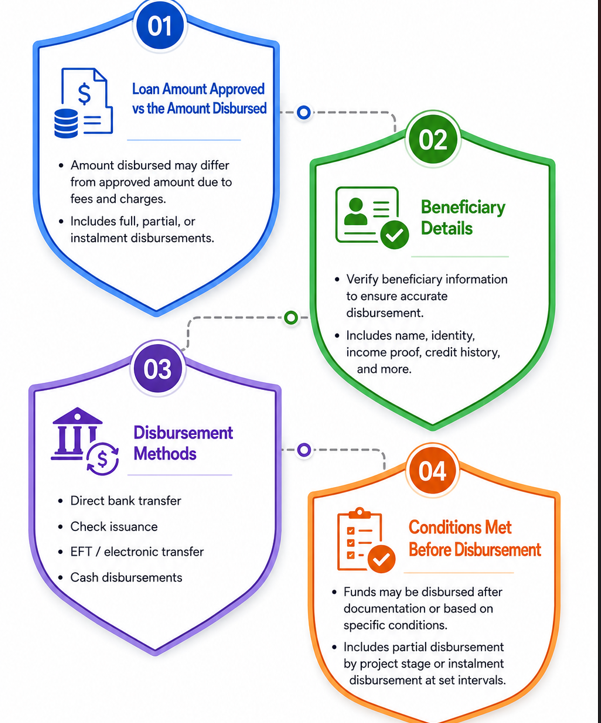
A typical reconciliation will cover the following key details of loan disbursement.
1. Loan Amount Approved vs the Amount Disbursed
The loan amount approved is often different from the disbursed amount, as lenders deduct fees to cover administration and transaction processing costs.
Apart from this, the disbursement amount can also vary based on the type of disbursement, which can be full, partial or in instalments. Both these scenarios must be accounted for in the reconciliation process.
2. Beneficiary Details
Since banks process multiple loans in a day, there is no doubt that they may come across borrowers who have the same names. Therefore, ensure accuracy in disbursement by reconciling it with the beneficiary details like name, identity and income proofs, credit history, etc.
3. Disbursement Methods
A lender can disburse loan funds through a variety of methods. These include
- Direct bank transfers where money is credited to the borrower’s account
- Issuance of a check, which the borrower deposits into their bank account
- EFT or electronic fund transfer
- Cash disbursements
4. Conditions Met Before Disbursement
For some loans, the funds are fully credited to the borrower once they have completed documentation. In other cases, loan disbursement can be conditional, such as partial disbursement, where funds are credited on completion of a project stage, or instalment disbursement, where a fixed portion of funds is credited at scheduled intervals. During the loan disbursement reconciliation process, these conditions must also be matched with credit data.
{{banner1}}
The Loan Disbursement Process
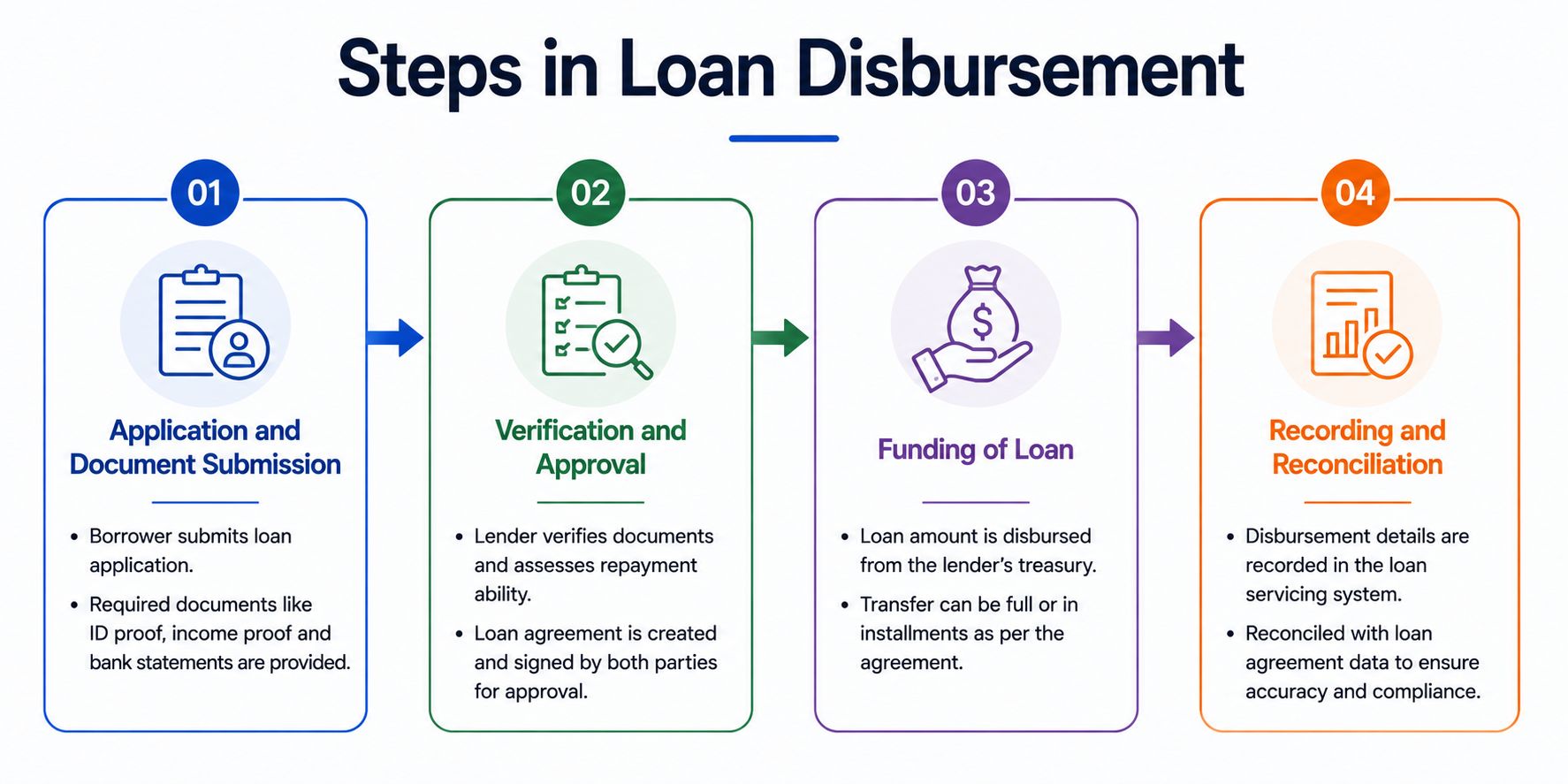
Lenders, whether banks or financial institutions, follow similar steps in the loan disbursement process. These include
1. Application and Document Submission
The process starts with a borrower making a request for a loan by submitting an application and the required documents to the lender. These documents include proofs of identity, address, income, bank statements, etc.
2. Verification and Approval
The lender reviews these documents for accuracy and analyses the repayment potential of the borrower. Once satisfied, a formal loan agreement is created that specifies terms and conditions. The loan is approved when the agreement is signed by both parties.
3. Funding of Loan
The approval process is followed by the disbursement of the loan from the lender's treasury. It can be a full fund transfer right after the contract is signed or partial transfers as agreed upon in the contract.
4. Recording and Reconciliation
Lastly, the disbursement details are recorded within the loan servicing system of the lender and reconciled against the loan agreement data for compliance purposes.
Why Loan Disbursement Reconciliation Matters
There are many loans being processed every day. The process does not end at approval and disbursement, but also requires reconciliation of outlay data with internal data for the following reasons.
1. Identifying errors like overstated or understated loan balances.
2. Compliance with IFRS and other reporting requirements.
3. Maintaining borrowers' trust with early detection and rectification of disbursement mistakes like wrong amount, account or timing.
Common Loan Disbursement Reconciliation Challenges
Even with good processes in place, there are instances when bank reconciliation teams can face issues. These include
1. Failed Payments
There are instances when the lender disburses the loan, but the amount is not credited to the borrower due to incorrect account details, technical issues or pending beneficiary verification.
2. Duplicate Disbursements
Manual and siloed reconciliation processes carry the risk of recording a single disbursement twice, causing inaccuracies in the bank’s financial data.
3. Amount Mismatch
Loan agreement conditions and processing fees can result in a mismatched loan amount during approval and disbursement. Reconciliation teams have to be careful about accounting for these differences.
4. Multiple Data Sources
During reconciliation, the lender reconciliation teams have to pull multiple records containing data on disbursement, loan agreements, beneficiary details and match them. Manual processing of them can lead to high errors during reconciliation, such as mismatched amounts or omissions, and consume significant time.
Manual vs Automated Loan Disbursement Reconciliation
Loan disbursement reconciliation involves gathering data from loan servicing systems, borrower information, loan agreement and other necessary sources. Going line by line to match these records is an extremely slow and error-prone task, especially when lenders are processing thousands of loans each day.
Automation platforms like Osfin change this entirely. They are equipped with tools to automatically ingest data from multiple sources, apply matching rules, flag anomalies for human review and create reports on reconciliation. The whole reconciliation, which took hours, if not days, to complete, is finished by automation platforms in minutes.
How Osfin Automates Loan Disbursement Reconciliation
Osfin is an intelligent automation platform built specifically to handle high volumes of financial operations. It serves enterprises across banking, payment & cards, fintech, etc and is especially suitable for loan disbursement reconciliation with its following features.
1. Multi-Source Data Ingestion
Osfin is a file format-agnostic platform, equipped with 170+ connectors, that automatically captures data from multiple sources regardless of the format.
2. Intelligent Matching
It applies logic-based matching rules to one-to-many and many-to-one transactions and performs multi-way reconciliation such as 2-way, 3-way, 4-way and 5-way. Osfin is proven to reconcile 30 million transactions in 15 minutes.
3. Exception Handling
Osfin's exception handling engine automatically flags unmatched data, such as failed payments, duplicated or amount variance, assigns them the correct reasons and routes them to appropriate team members for review.
4. Data Security
Osfin understands the need to protect loan, beneficiary and other banking data; therefore, it protects it with 256-bit encryption, role-based access and two-factor authentication. This protection is backed by global compliance certifications like SOC 2, PCI DSS, ISO 27001 and GDPR.
5. Audit Readiness
A major reason for lenders to perform loan disbursement reconciliation is their need to comply with IFRS and central bank reporting requirements. Osfin assists you in this process by delivering compliance reports and maintaining audit-ready workflows.
{{banner1.1}}
Best Practices for Disbursement Reconciliation
Loan disbursement reconciliation is non-negotiable for banks and financial institutions, as they must maintain operational accuracy. Delays or mistakes in loan-related data directly impact the lender’s reputation among its customers. The following best practices can help them avoid this risk and streamline their reconciliation process.
1. Reconcile Daily
Banks and financial institutions process many high-volume transactions throughout the day. By reconciling loan disbursement data daily, they can easily identify and escalate discrepancies and errors, helping them maintain the accuracy of their financial records.
2. Standardise Naming Convention
Loan-related data such as bank disbursement records, beneficiary information, loan agreements, etc are often scattered across systems. By standardising file naming and keeping consistent field mapping, lenders can reduce confusion during the reconciliation process.
3. Leverage Automation Tools
Manually processing and reconciling hundreds of lines of loan disbursement data increases the risk of errors and delays. By using automation tools like Osfin, you can increase the speed and accuracy of your bank loan reconciliation.
Wrapping Up
Loan disbursement reconciliation is non-negotiable for banks and financial institutions if they keep their lending data accurate, maintain borrowers’ trust and comply with reporting requirements. But manual processes often result in delays and high amounts of errors, which can pile up and cause problems with your financial reports.
This is where Osfin helps you by automating the whole reconciliation process from data ingestion to generating reports. Osfin’s applier logic-based matching rules speed up reconciliation, while its exception handling engine flags anomalies and routes them to appropriate personnel.
{{banner2}}
FAQs
1. What are the types of loan disbursement reconciliation?
The types of loan disbursement include full (lump sum), partial, instalment, direct and deferred disbursements.
2. What steps are followed in the loan disbursement process?
The loan disbursement starts with the borrower making a loan request by submitting an application with the required documents. The lender verifies these documents, approves the loan and creates an agreement contract specifying its terms and conditions. Once this loan agreement is signed by both parties, the funds are disbursed to the borrower.
3. What are the types of loan disbursement methods?
Loans can be disbursed by the lender through direct bank transfers, check issuance, electronic fund transfer and cash disbursement.
4. What are common challenges in the loan disbursement reconciliation?
Some of the common challenges in loan disbursement reconciliation are failed payment, duplicate disbursements, amount mismatch and multiple source data.