Modern Treasury Pricing: Plans, Features & Cost
Modern Treasury has built a strong reputation as a payment operations platform. It promises faster money movement, real-time ledgering, and payment automation, all through a single API. But in some cases, a payment platform may not be enough.
All financial institutions operate differently, and the same goes for their needs. While some require mere movement of money, others are more concerned about reconciling it, accounting for it, and keeping every record clean and audit-ready.
Here is a guide for such institutions. We’ll cover what Modern Treasury offers, its pricing, where it falls short, and what a reconciliation-first alternative looks like.
What is Modern Treasury?
Modern Treasury is a fintech platform that works as an integrated payment service provider and a ledgering system. It allows organizations to send and receive money across multiple payment rails, including ACH, wires, RTP, FedNow, and stablecoins. In addition to that, it offers real-time ledgers to track balances, transactions, and money movement.
What Can You Do with Modern Treasury?
Here’s all that you can do using Modern Treasury:
1. Cross-Border Payments
You can send or receive money across borders using a single API and capture all transactions, FX gain, loss, and settlement in your ledger. You can also support multi-currency wallets (e.g., a user holding both USD and EUR) with accurate balances for each.
2. Payroll
It enables near-instant payroll disbursements via FedNow, ACH, RTP, wire, and USDC, and keeps all balances and transactions synced in one system. Compliance (KYB/KYC) is also built in, so there's no need to open separate FBO accounts or build bank integrations.
3. Digital Wallets
You can build digital wallets to hold and transfer money. It gives you the infrastructure to handle wallet funding, payments, and reconciliation, supporting both fiat (USD) and stablecoins (USDC).
4. Lending
It lets you automate loan originations, repayments, and interest tracking with ledgers that scale and payments that settle instantly. You can fund loans via RTP/FedNow in real time and reconcile transactions automatically.
Modern Treasury Pricing Details: What We Know
Unfortunately, Modern Treasury pricing cannot be determined from the platform’s website. The pricing is not shared with the public. Their pricing page prompts the user to fill out their details and schedule a call with their team. However, it’s made clear that Modern Treasury follows a usage-based pricing, where users pay according to their usage levels and transaction activity.
The exact pricing is based on the volume of transactions, the number of payment rails your organization deals with, and your account structure.
Pros and Cons of Modern Treasury
Modern Treasury is well-regarded by its users, particularly among developer-led fintech teams. However, like any platform, it has clear strengths and areas where it falls short depending on the use case and company profile.
Modern Treasury's strengths
- Well-designed API interfaces that are well-documented and easy to use.
- Simplifies payment processes with automation of workflows.
- Powerful integrations with several banks.
- Clean, intuitive UI and responsive customer support.
- Users can go live in just a few days.
Modern Treasury's weaknesses
- Occasional complaints of bugs and performance slowdown.
- Does not integrate with all banks, and the charges to execute direct file transmission can be high.
- Tends to be complex for non-technical users.
- Can be confusing for new users. Its documentation can be better.
- Reconciliation coverage has gaps for specific use cases. Check deposits, many-to-one, and one-to-many matching are not natively supported.
- Can be expensive for small-volume companies.
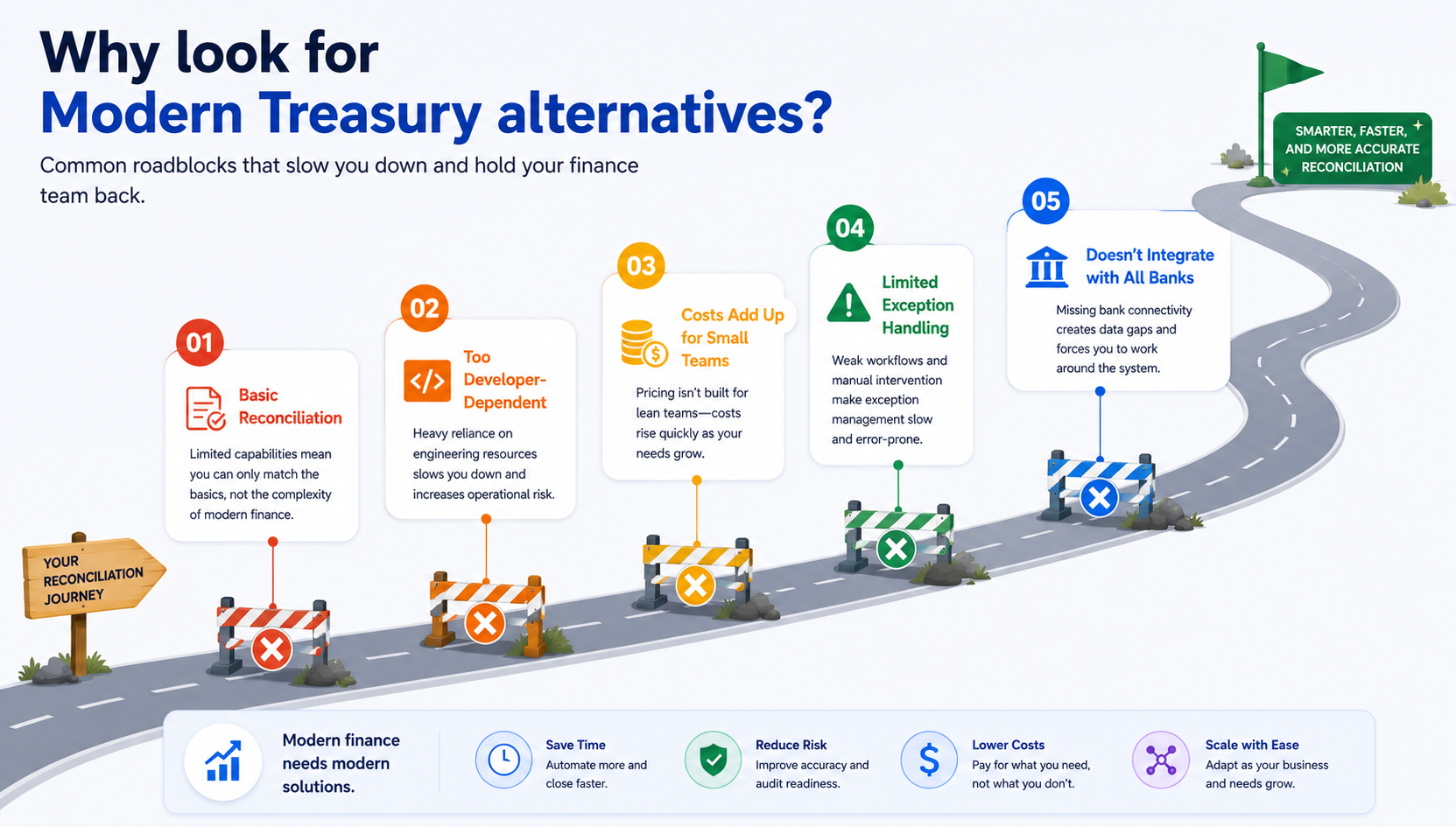
When Should You Reconsider Modern Treasury?
Modern Treasury might not be the best fit for certain categories of financial operations and institutions. Here are the signs that indicate it may be time to look for alternatives:
- Your reconciliation needs are complex: Modern Treasury's reconciliation works well for basic scenarios. If you're dealing with multiple data sources in different formats and complex matching patterns like many-to-one or one-to-many, you'll need to reconsider.
- Your transaction volumes are scaling fast: At higher volumes, reconciliation lag and exception management start to consume significant team time that platforms with automation can easily handle.
- Your tooling demands more engineering prowess than your team can spare: Modern Treasury requires dedicated technical resources. For organizations without a standing developer team, a costly dependency is created that slows down operations.
{{banner1}}
A Better Alternative: Osfin for Product-Led Growth
Osfin is a financial reconciliation automation platform that makes sure every transaction your business deals in is accurately accounted for, across every system you use.
Unlike Modern Treasury, which is built around payment execution, Osfin is purpose-built for the harder problem, that is, making sense of money after it moves. It ingests data from 170+ sources, including banks, payment gateways, and ERPs, normalizes it regardless of format, and matches it with 100% accuracy at high speed.
Where Modern Treasury requires engineering resources to configure and maintain, Osfin is a low-code platform that finance and operations teams can set up and run without depending on a developer. Osfin also reconciles across your entire financial ecosystem, including complex matching patterns that MT doesn't natively support.
Why is Osfin a Better Fit?
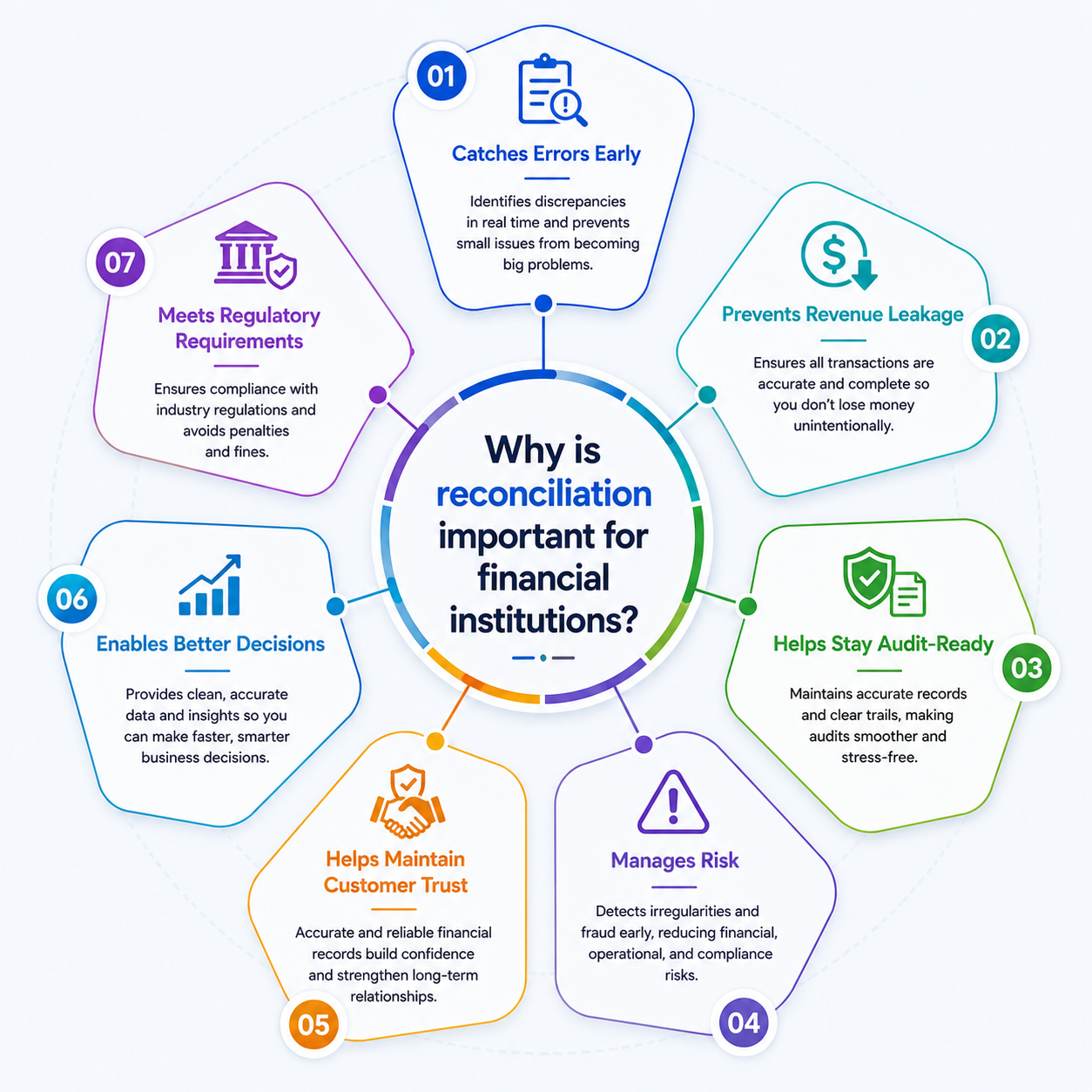
Moving money is only half the problem. The harder half is knowing, with complete certainty, that every transaction is accurately recorded, matched, and accounted for across every system your financial institution runs on. That is precisely what Osfin is built for.
1. Purpose-built reconciliation engine: Osfin is a reconciliation platform built from the ground up. It handles the full spectrum of complex matching patterns, covering complex real-world financial flows that MT does not natively support.
2. 170+ integrations: Osfin connects with over 170 systems, including CBS, payment gateways, switches, payment networks, ERPs, and internal databases. And can work with data in any format, such as BAI2, XML, CSV, MT940, ISO 20022, TXT, or JSON with no difficulty.
3. Low-code, finance-team friendly: Osfin is a low-code platform, requiring no technical expertise. Finance and operations teams can configure workflows, set matching rules, and adapt the system as their business evolves, without raising tickets.
4. 100% auto match rate with built-in exception handling: Osfin's logic-driven matching engine achieves a 100% accuracy rate, leaving minimal exceptions for teams to manage. In case of exceptions, the built-in exception management module escalates them and helps in faster resolution.
5. Complete audit trails: All the transactions, matches, and adjustments are logged in an immutable audit trail. There is no manual data pulling or after-the-fact reconciliation.
6. Broader industry coverage: Osfin serves banking, fintech, insurance, capital markets, and not just API-first fintech companies. Whatever industry you operate in, Osfin has purpose-built solutions.
{{banner3}}
How Osfin Offers Better Value?
To understand how Osfin is built differently to offer better value, let’s have a look at a detailed breakdown of its workflow:
Step 1: Data Ingestion
Osfin starts by pulling in data using its 170+ pre-built integrations. Its format-agnostic feature means it can handle any data format without requiring any pre-formatting or transformation on your end.
Before a single record moves to matching, it applies custom deviation tolerances to tease out poor-quality data, and automatically pinpoints duplicates and outliers at the point of ingestion to prevent downstream errors.
Step 2: Reconciliation
After the data is ingested and cleaned, Osfin's logic-based matching engine gets to work. It goes well beyond simple one-to-one matching, handling one-to-many, many-to-one, and multi-way reconciliations, including two-way, three-way, four-way, and five-way matching. This makes it capable of reconciling the kind of complex, financial rails that most platforms struggle with.
The speed is equally noteworthy. Osfin processes up to 30 million records in just 15 minutes. It also auto-reconciles payment gateway reports with commission, tax, and fee breakdowns, removing what is typically one of the most time-consuming manual tasks in a finance team's workflow.
Step 3: Exception Handling
No reconciliation process is without exceptions, but what separates Osfin is what happens when they arise. Every unmatched transaction is automatically flagged with an accurate reason code, so teams are never left guessing why something didn't match.
From there, Osfin's ticketing and exception handling engine escalates and routes unresolved items to the right team member.
The live dashboards are an added advantage, giving finance teams real-time insights about the match status, financial exposure, and exception queues. This way, your entire team is always privy to where things stand.
Step 4: Output and Compliance
Osfin delivers compliance-ready reports with full transaction traceability and audit history, so your finance team is ready for internal reviews or external audits anytime.
On the security front, data is protected with 256-bit encryption, maker-checker workflows, role-based access controls, and two-factor authentication. Osfin is also fully compliant with SOC 2, PCI DSS, ISO 27001, and GDPR, meeting the security and regulatory requirements of financial institutions.
Choose What Truly Serves Your Growth!
Modern Treasury has earned its place in the fintech ecosystem. For developer-led teams that need to move money quickly across multiple payment rails, it delivers real value. If your primary challenge is payment execution, it is a capable platform worth considering.
But financial operations rarely stay simple for long. As transaction volumes grow, data sources multiply, and reconciliation complexity deepens, the gaps in any payment-first platform begin to show.
The real question is which platform can keep up with your business as it scales, without adding headcount, engineering dependencies, or manual workarounds to compensate for what the software cannot do.
If the problem in your financial operations isn't payment execution but everything that comes after it – matching, exceptions, reporting, and audit readiness – that is exactly what Osfin is built to solve.
{{banner1.1}}
FAQs
1. How much does Modern Treasury cost?
Modern Treasury pricing is not made public. You’ll have to contact the platform’s sales team for a custom quote. The pricing is usage-based, where you pay according to your use of the platform. It usually depends on the payment rails, account structure, and volumes of your transactions.
2. Why look for Modern Treasury alternatives?
Modern Treasury is built around payment execution, and it does that well. But when reconciliation gets complex, transaction volumes spike, your institution deals with multiple data sources and formats, and your finance team can't rely on developers, it starts to show its limits.
3. What is a better alternative to Modern Treasury?
For teams where reconciliation is the real issue, Osfin is built exactly for that. It automates the entire reconciliation lifecycle, from data ingestion to audit-ready outputs, across every system your organization runs on.
4. How is Osfin different from Modern Treasury?
Modern Treasury is responsible for moving money across multiple payment rails. Osfin, on the other hand, ensures every transaction that is transferred is accurately reconciled, matched, and audit-ready across every system you operate.