BlackLine Pricing: Features, Packages & Costs
Management of financial operations has never been easier. But with transaction volumes growing and multiplying data sources, the tools you rely on for this start to matter a lot more.
BlackLine is one of the most recognized names in financial close management, trusted by large enterprises to bring structure and control to their accounting processes. But in some cases, it isn’t the right fit.
Here, we’ll uncover what those specific scenarios are, what BlackLine actually offers, and what can be used in its place.
What is BlackLine?
BlackLine is a financial close management solution that helps organizations simplify their financial processes, like invoice-to-cash, record-to-report, and intercompany operations.
Verity AI, the platform’s Agentic AI, provides automation capabilities and deeper control and accuracy over financial operations without overburdening your finance teams.
BlackLine also integrates within itself Studio360, a platform that combines five components:
- Integration of data (Integrate)
- Optimization of workflows (Orchestrate)
- 360˚˚ view of operations and real-time analysis (Visualize)
- Extensive library of process design templates (Blueprint)
- Unifying control for access and permissions (Control)
What Can You Do with BlackLine?
Using BlackLine, an organization can streamline the following operations:
Financial Close
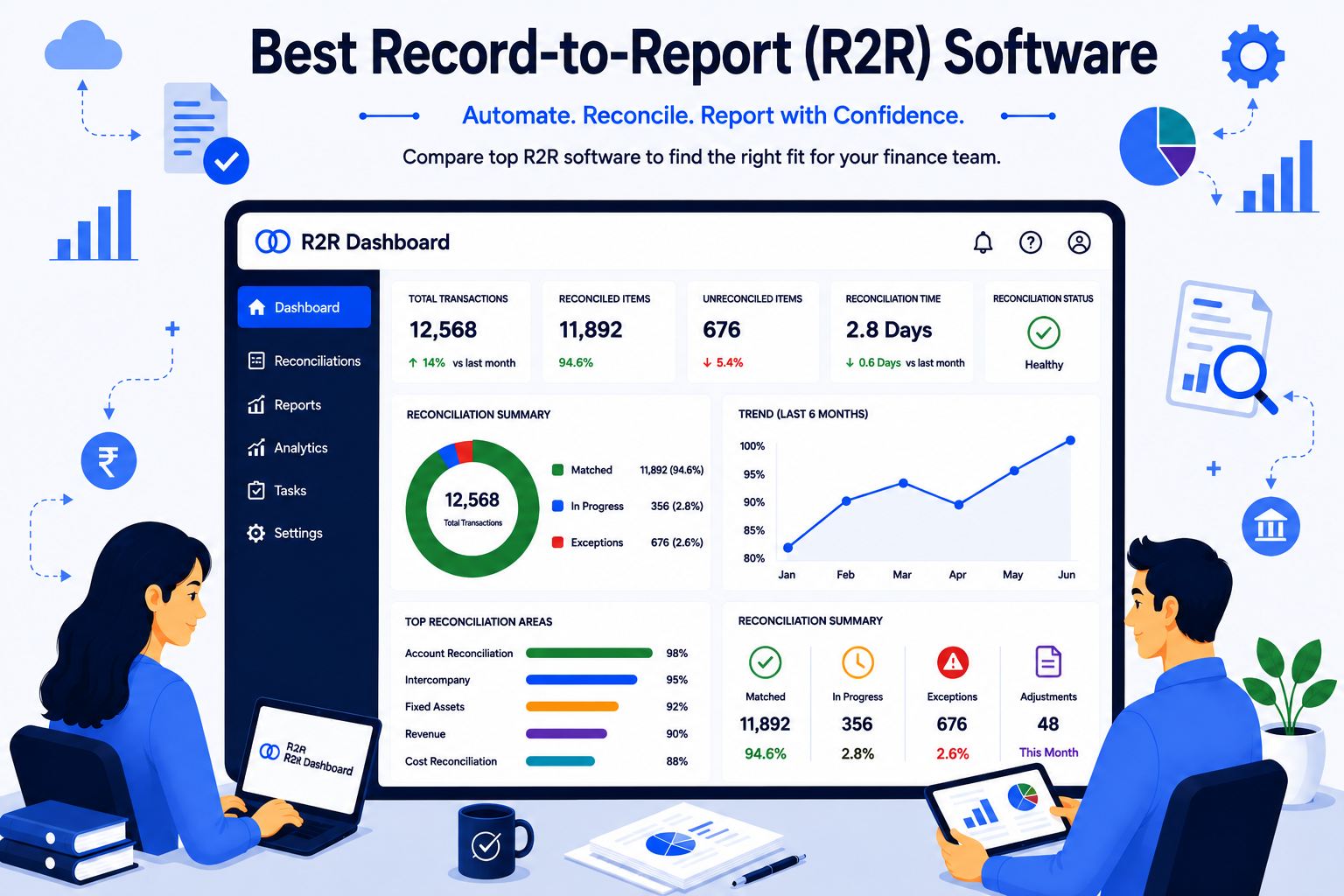
1. Reconciliation: Mitigate errors associated with manual account reconciliations with the added advantage of compliance and audits achieved through financial reporting.
2. Transaction Matching: Reduce time spent on transaction matching by automating matching in complex scenarios.
3. Journal Entry: Automate the creation, validation, review, and posting of journal entries via smooth ERP integrations.
Intercompany
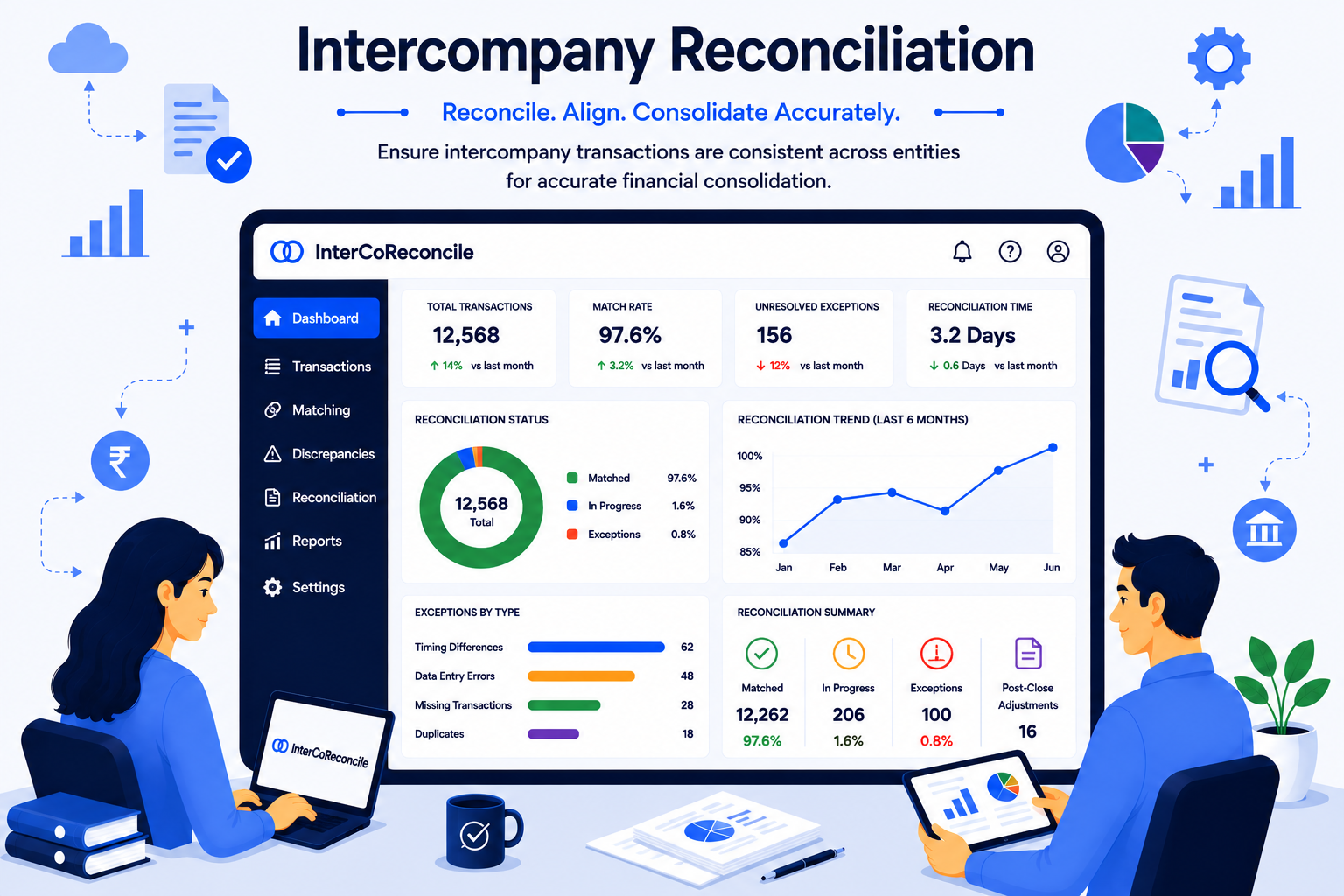
1. Transaction Management: Prevent intercompany errors at their source by automatic generation of granular, line-item level transactions directly from source data.
2. Balance and Resolve: Detect mismatches between different entities and fix them automatically so the data is clean and ready for close.
Invoice-to-Cash
1. E-invoicing: Send invoices, get paid faster, reduce manual work, and keep your organization compliant with tax rules.
2. Credit and Risk Management: Monitor how customers pay, spot risky accounts, and make better credit decisions.
3. Cash Application: Automatically match customer payments to the right invoices in your ERP.
BlackLine Pricing Details: What We Know
On the pricing front, not much has been shared publicly. You’ll have to contact the platform’s sales team to get a custom quote. However, it uses a subscription-based model. And the pricing most likely depends on the modules you are licensing, the number of subsidiaries your organization has, the usual volume of transactions, contract terms, and the number of customer accounts.
What Drives BlackLine's Costs Up?
Although there’s not much clarity about the exact BlackLine pricing, the following can definitely drive up your costs:
- Large number of users
- High number of modules licensed
- Shorter contracts
- Large size of the organization
- Additional features
Pros and Cons of BlackLine
To get an idea about how exactly BlackLine performs, let’s have a deeper look at its various strengths and weaknesses and whether the pros outweigh the cons.
BlackLine's strengths
- Centralizes financial close activities and automates reconciliations.
- AI-driven matching rules reduce manual data entry and free up your accounting teams to take care of strategic work.
- Clear visibility on close status and mismatches via real-time dashboards.
- Strong integration with major ERPs like SAP and Oracle.
BlackLine's weakness
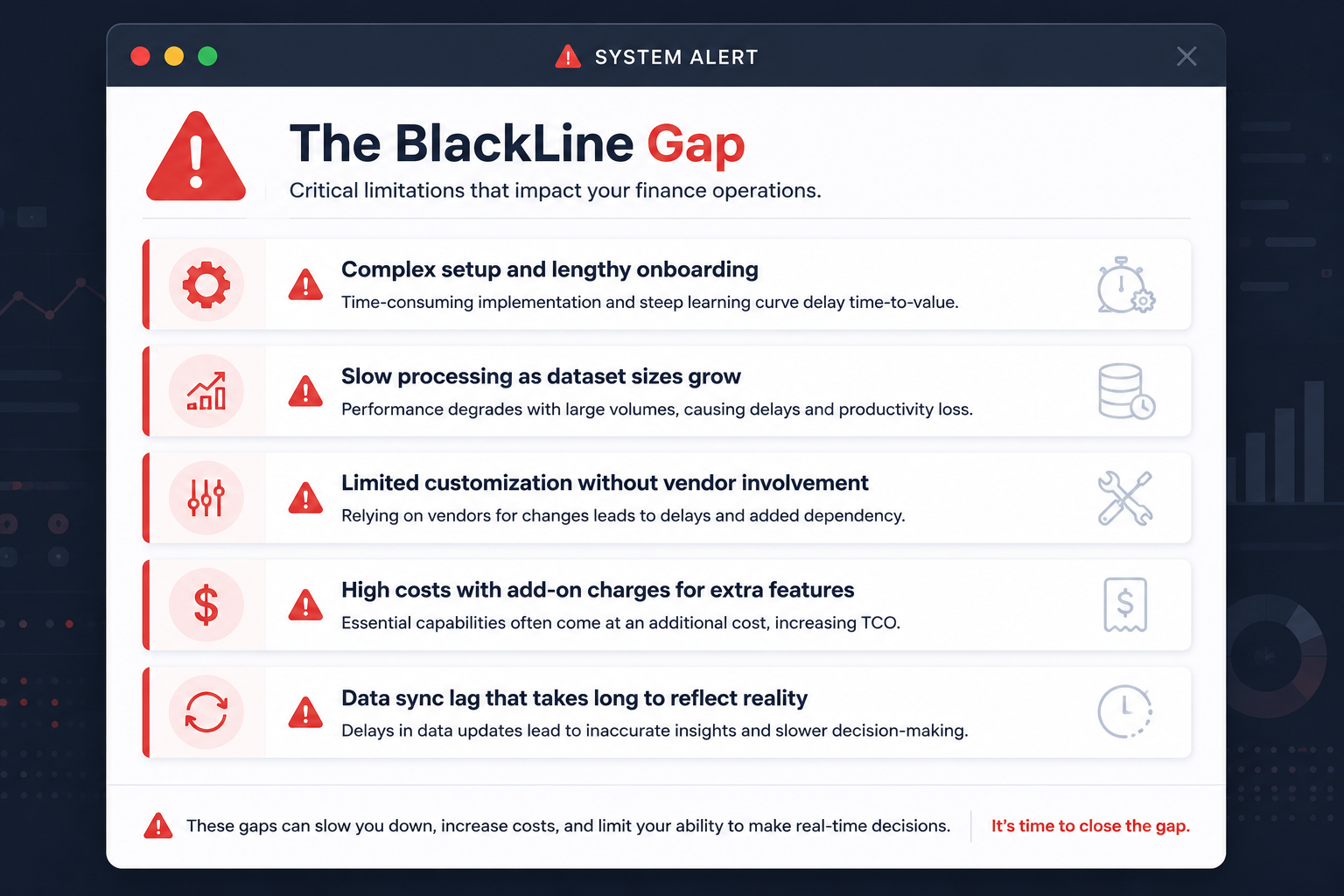
- Complex learning curve for new users, as it takes quite a lot of time for setup and training.
- Performance can degrade as the dataset you’re dealing with increases.
- Additional features can quickly burden small organizations with high costs.
- The reporting dashboard seems basic and may require the use of third-party tools for advanced analytics.
- Limited capabilities when it comes to customization of workflows as per your organization’s requirements.
- Data sync lag between BlackLine and connected systems can take up to a day to reflect updates.
- Module dependency means you only get full value when all modules are in use together. Standalone usage delivers limited returns at high cost.
When Should You Reconsider BlackLine?
So far, it’s been made quite clear when you can use BlackLine. But there are certain situations where BlackLine falls short, and you’ll need to look for its alternatives. These scenarios include when:
- You need speed at scale: BlackLine's performance degrades as dataset sizes grow. If your business processes millions of transactions daily, across payment gateways, banks, and internal systems, waiting on a slow platform isn't an option.
- Reconciliation is your core problem: BlackLine is built around the financial close cycle. For continuous, high-volume transaction reconciliation daily, and not just at month-end, you need to reconsider.
- Your team can't afford a long setup: Combining BlackLine’s implementation, training, and onboarding takes a lot of time and resources. For teams that need to move fast, it’s better to look for alternatives.
- You operate outside traditional corporate finance: BlackLine was designed for accounting teams. Banks, fintechs, payment companies, insurance providers, and capital markets firms have reconciliation needs that go beyond what a close management tool is built to handle.
{{banner1}}
A Better Alternative: Osfin for Product-Led Growth
For all the scenarios mentioned above, Osfin presents a far better option. It’s built to automate your financial and accounting operations with lightning-fast speed and 100% accuracy. With Osfin, there’s no long implementation timeline, module dependency, or degrading performance as your volumes grow. It’s designed for financial institutions that process millions of transactions and need reconciliation that keeps up.
Osfin is a Better Fit for Product-Led Growth
Product-led growth works when your tool doesn't need a six-month implementation to get going and delivers value fast. Osfin is built exactly that way.
- Fast time to value: Across industries, from e-commerce to fintech to banking, Osfin’s customers have gone live and seen measurable improvements within mere weeks.
- Your team is in control: Osfin's low-code platform means your operations team can configure rules, adapt workflows, and respond to new requirements on their own.
- Results that scale: Regardless of the volumes of transactions you’re processing, the outcomes remain consistent – higher automation rates, fewer manual exceptions, and significant cost savings.
- Shorter reporting cycles: With clean and fast reconciliation, financial reporting doesn't have to wait for it. Osfin’s customers have consistently seen their reporting cycles shorten after they go live.
{{banner1.1}}
How Osfin Offers Better Value?
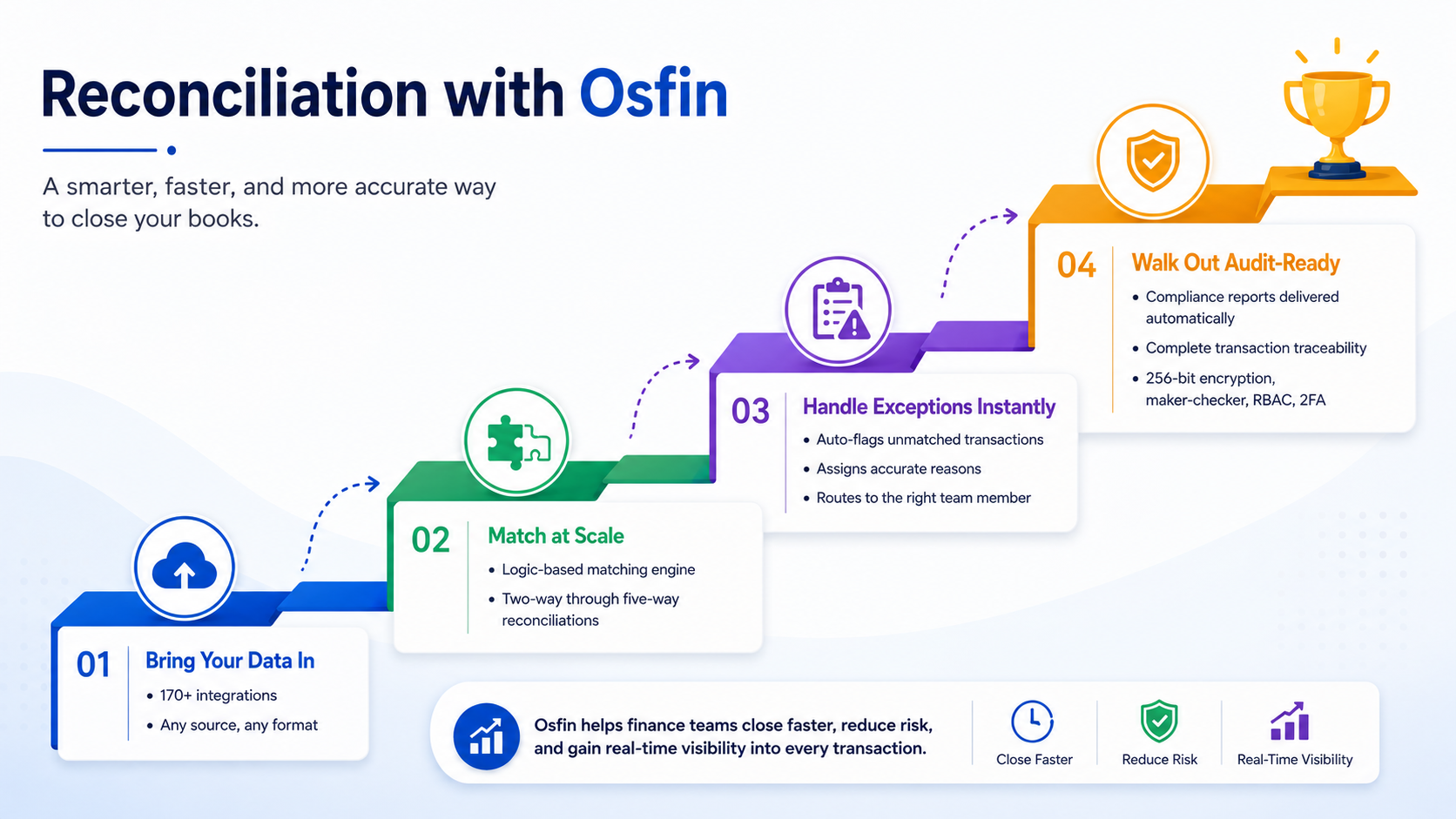
Moving beyond the broad financial close focus of BlackLine, Osfin delivers a purpose-built reconciliation engine built for speed, scale, and complexity of modern financial operations. Its focus is on regular, high-volume reconciliation that runs every day, across multiple sources, with zero performance trade-offs as your data grows. This is how it works:
Ingestion that handles your data as-is
Osfin is file-format agnostic, connecting to 170+ integrations to pull in data from banks, payment gateways, ERPs, internal databases, and more. That too, in any format, without requiring your team to standardize anything upfront.
Its custom deviation tolerances tease out poor-quality data before reconciliation begins. And duplicates and outliers are caught right at the point of ingestion, so nothing bad reaches the matching stage.
Matching aligned with your volumes and sources
Osfin's logic-based matching engine handles one-to-many, many-to-one, and multi-way reconciliations, across two-way through five-way. It also auto-reconciles payment gateway reports with commission, tax, and fee breakdowns, without degradation or bottlenecks.
Smooth and fast exception handling
In case a transaction doesn't match, Osfin automatically flags it, gives it a valid reason, and routes it to the right team member through its built-in ticketing and exception handling engine.
Moreover, the live dashboards give your team a 360˚ view in real-time of match status, open exceptions, and exposure. That way, every unmatched transaction has an owner and a resolution path.
Output your auditors will never question
Every reconciled transaction comes with complete traceability and transaction history. Osfin prepares compliance reports and maintains audit-ready workflows automatically.
Plus, it secures data with 256-bit encryption, maker-checker flows, role-based access, and two-factor authentication, and is compliant with industry standards like SOC 2, PCI DSS, ISO 27001, and GDPR.
The result is a reconciliation process that is 100% accurate, faster than most platforms, and completely scalable, without the complexity of tools built for a different problem.
Choose What Truly Serves Your Growth!
Every organization has a different way to work as per its own set of requirements. That means your choice should be based on what your business actually needs.
For large enterprises with dedicated accounting teams, the budget for a full suite, and the IT bandwidth to support a long implementation, BlackLine does the job. It's a well-built tool for managing the financial close cycle.
If your team is dealing with transaction volumes that grow every quarter, data arriving from multiple sources in inconsistent formats, or reconciliation that needs to run continuously, then the platform you invest in should be built for exactly that. One that ingests your data regardless of format, matches at the speed your volumes demand, surfaces exceptions before they become liabilities, and keeps you audit-ready without the scramble.
That's the problem Osfin was built to solve. And the difference shows up in hours saved, errors caught, and audits passed without a last-minute scrambling.
{{banner3}}
FAQs
1. What is BlackLine used for?
BlackLine is a financial close management platform for large enterprise accounting teams that manage reconciliations, journal entries, and close cycles. The platform, basically, brings structure and visibility to the month-end close process.
2. Who is BlackLine best suited for?
BlackLine works best for large enterprises with dedicated accounting teams, significant IT bandwidth, and the budget to support a full implementation. It's built for corporate finance, not high-volume transaction operations.
3. What are BlackLine's biggest limitations?
BlackLine has a complex learning curve, and users often complain about slow performance issues with large datasets, limited customization, and high costs. Plus, changes often require vendor involvement.
4. How is Osfin different from BlackLine?
BlackLine manages the financial close. Osfin handles high-volume transaction reconciliation for financial institutions that need transactions matched every day with complete accuracy, high speed, and efficiency.