How to Investigate Reconciliation Discrepancies
Key notes:
- You need to investigate all the discrepancies. Even small gaps can hide bigger problems.
- Know what type of discrepancy you're dealing with before you start investigating. It saves a lot of time.
- Always go back to the original document. That's your only reliable reference point.
- If the same issue keeps coming back, something in your process is broken. Fix that.
- Investigate early. Old discrepancies are much harder to trace than fresh ones.
- Maintain a record of every discrepancy and what you did to fix it.
Discrepancies are a part and parcel of any kind of reconciliation. What you do when you find one is what really matters. A gap in the numbers could be a timing issue, a missed entry, or something that needs immediate attention. There's really no way to know until you investigate.
Investigating discrepancies properly is what separates your team from one that is always playing catch-up.
Why Investigating Discrepancies Matters
A reconciliation discrepancy happens when two sets of financial records don't match. It could be your internal ledger versus a bank statement. Or a customer order versus a vendor invoice. The gap may look small. But ignoring it can be costly.
Issue is that you never really know if a discrepancy is harmless until you look into it. The only way to find out is to investigate.
Because if discrepancies go unchecked, books don't close on time, audit trails weaken, and your finance team can end up spending hours in the chase of numbers instead of doing what they're meant to. And if regulators come knocking, unresolved gaps become a serious liability.
There's also the trust factor. Repeated discrepancies chip away at confidence in your financial data. Leadership loses faith in the numbers. And that’s hard to rebuild.
Types of Discrepancies
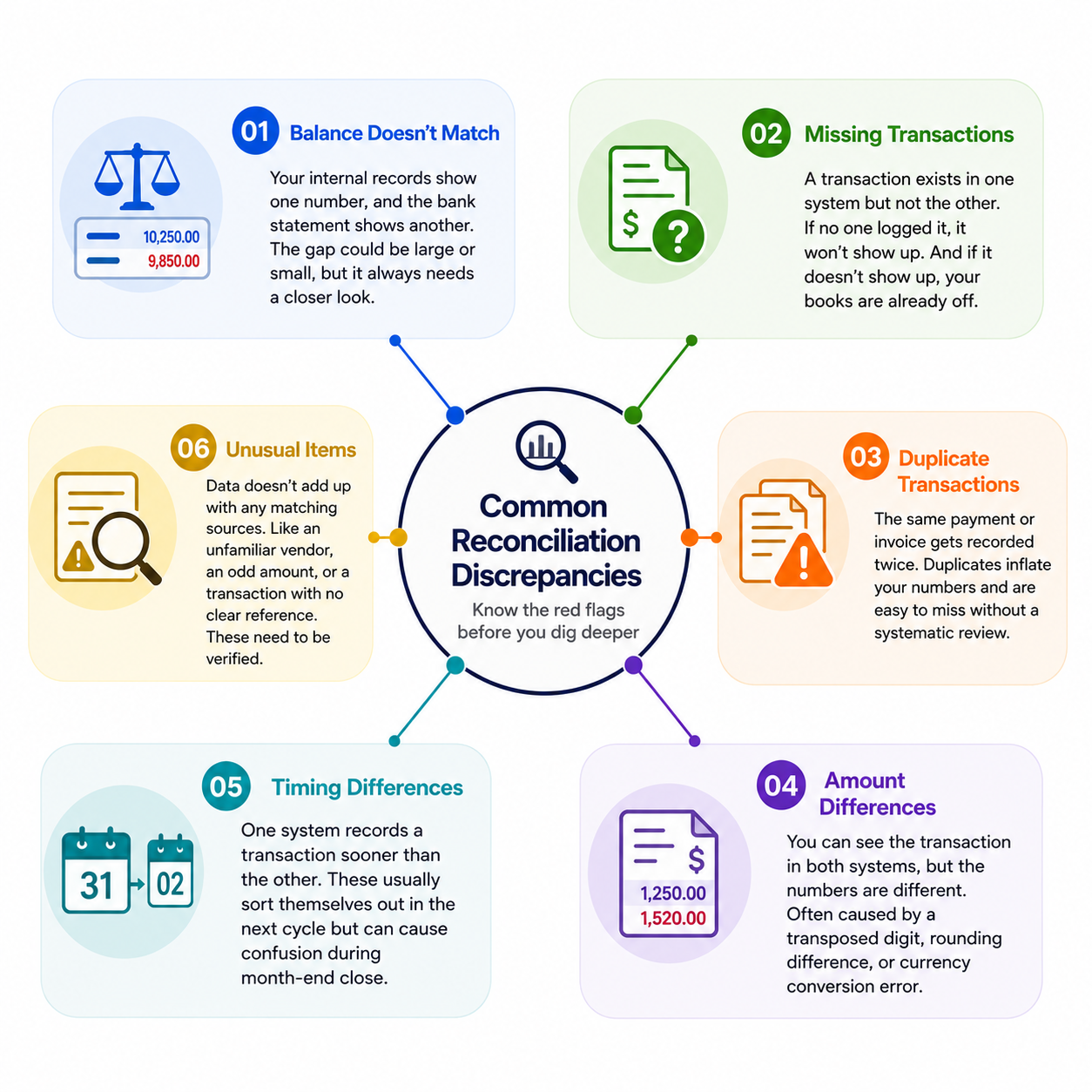
Before you begin a discrepancy investigation, it's better to understand what types of discrepancies you are dealing with.
Balance Doesn't Match
This is the most obvious sign that something is off. Your internal records show one number, and the bank statement shows another. The gap could be large or small, but it always needs a closer look. Sometimes it's a single missed entry. Other times, several smaller issues have added up.
Missing Transactions
A transaction exists in one system but not the other. Bank fees, interest charges, automatic payments – these often slip through because they don't trigger a manual entry. If no one logged it, it won't show up. And if it doesn't show up, your books are already off.
Duplicate Transactions
The same payment or invoice gets recorded twice. This can happen when a bank feed auto-imports a transaction that was also entered manually. Or when two team members log the same entry. Duplicates inflate your numbers and are easy to miss without a systematic review.
Amount Differences
You can see the transaction in both systems, but the numbers are different. The common culprits for these types of errors are a transposed digit, a rounding difference, or a currency conversion gone wrong.
Timing Differences
One system records a transaction sooner than the other. For instance, a check issued on the 31st might not clear the bank until the 2nd. A wire transfer shows in your ledger today but hits the bank tomorrow. These usually sort themselves out in the next cycle. But during month-end close, they can cause real confusion if not noted.
Unusual Items
Sometimes data doesn’t add up with any of the matching sources. Like an unfamiliar vendor, an odd amount, a transaction with no clear reference. These need to be verified.
{{banner1}}
Steps to Investigate Your Reconciliation Discrepancies
Follow the given steps to investigate reconciliation discrepancies in your processes:
1. Start by describing the gap clearly. Write down exactly what you see on each side. That clarity makes everything that follows faster.
Also check the basics before going deeper. Are the dates aligned? Are you comparing the same period? Is there a currency conversion involved?
2. Before investigation, assess if the difference really matters. That’s materiality. It’s about if the discrepancy is large enough to affect your financial statements. You can use size, frequency, and business impact to decide how urgently to act.
3. Once it's clear that the difference is worth investigating, assign it a category. The most common root causes are timing differences, data entry errors, missing transactions, and duplicate entries. Apart from that, there can also be system or integration issues and unauthorised or suspicious activity.
Manual vs Automated Discrepancy Investigation
There are two ways finance teams investigate reconciliation discrepancies. One relies on people doing repetitive work across spreadsheets. The other uses software to do the heavy lifting.
How Manual Investigation Works
In a manual process, the finance team pulls data from CBS, ERPs, payment processors, switches, payment networks, and other internal and third-party records.
They line everything up in a spreadsheet and go through it row by row to look for gaps. When something doesn't match, they start the investigation. That usually follows checking emails, calling third-party source providers, and cross-referencing documents.
It works. But it is slow and exhausting. The time it takes scales directly with the volume of transactions. A small mismatch can take hours to trace. And when multiple people are involved, version control becomes its own problem.
The bigger risk is human error. Sustained, detail-heavy work under deadline pressure is exactly where mistakes happen.
How Automated Investigation Works
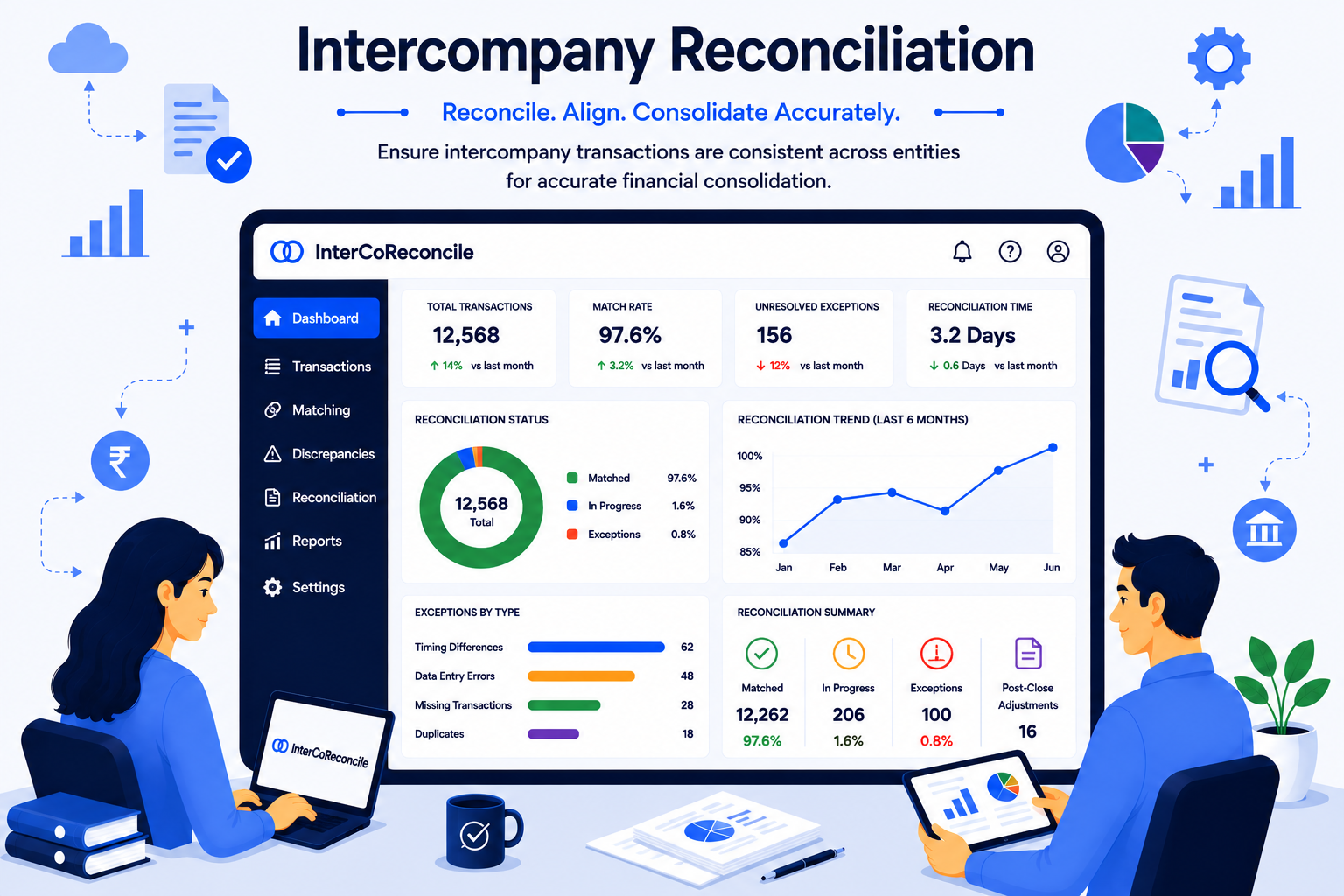
Automated reconciliation software connects directly to your data sources. And then it pulls everything in without manual export or copy-pasting. It applies predefined matching rules and runs through thousands of transactions in minutes. What matches gets cleared. What doesn't gets flagged as an exception and routed to the right person.
The team no longer reviews every transaction. They only look at what the system couldn't resolve.
{{banner1.1}}
Investigation Procedures for Each Type
For each type of discrepancy, you can take a different investigation route.
How to Investigate Timing Issues
Start by confirming whether the transaction actually exists in both systems, just at different dates. Pull up the entry in your internal records and find the corresponding posting date in other third-party sources. If the transaction appears in one place but not the other, check if it falls near a period cutoff.
Note it clearly in your reconciliation as a timing difference with the expected resolution date. No adjustment is needed in most cases. What matters is documenting it so the next person reviewing the records knows it's expected and already tracked.
How to Investigate Missing Items
Search both systems using multiple identifiers like amount, date range, vendor name, or transaction ID. Sometimes a missing item is actually a mislabeled one.
If it's truly missing, trace back to the source. Pull the original invoice or receipt that proves the transaction occurred. Then record the missing entry with proper documentation and adjust any affected balances.
How to Investigate Amount Differences
Locate both versions of the transaction, what your records show and what the external statement shows. And put them side by side. Look at the exact figures. Is the difference a round number? That often suggests a fee or charge that wasn't included. Is it a transposition, such as a figure being entered as a slightly different number? Is there a currency conversion in play?
Check whether the amount was recorded correctly at the point of entry. If someone keyed it in manually, check for typos. If it came through an integration, check if the data was imported cleanly. After you find the error, correct it in the affected system, document the adjustment, and note what caused it.
How to Identify Fraud Indicators
Look out for transactions that have no clear vendor name or reference and amounts that are slightly below approval thresholds. Or the same vendor appearing multiple times with slightly different names or payments routed to unfamiliar accounts.
If needed, place a hold on the account. Work with your internal audit team or an external professional to investigate properly.
Common Investigation Pitfalls to Avoid
Here are some pretty common mistakes you may encounter when you investigate reconciliation discrepancies:
1. Accepting Shallow Explanations
It’s quite easy to close a discrepancy the moment you have a plausible reason for it. But a quick explanation need not be the right one.
If you are unable to trace a discrepancy all the way back to a source document, your investigation isn't done yet. Better verify the explanation against actual records before marking anything resolved.
2. Not Investigating Fully
A discrepancy that's been identified but only partially looked into is still an open risk. Some teams stop once they find a likely cause, without checking if the correction was applied correctly, if other entries were affected, or if the same issue exists elsewhere in the data.
3. Ignoring Patterns
If the same discrepancy appears on and on, something is not right within your processes. Many teams treat every mismatch as a one-time thing and fix it in isolation.
Keeping a log of resolved discrepancies makes patterns visible over time. Without it, the same root causes get fixed and re-fixed indefinitely. And no one ever addresses the upstream issue that keeps producing them.
4. Waiting Too Long to Investigate
The longer a discrepancy sits unresolved, the harder it becomes to trace. Transaction trails go cold. People forget context. Supporting documents become harder to locate. And if the issue involves unauthorized activity, delay gives it more time to grow.
Investigating discrepancies close to when they occur is much easier than revisiting them weeks later during month-end crunch. A mismatch spotted this week can often be explained with a quick check. That same mismatch in a pile of unreviewed items at close takes hours to untangle and creates pressure to accept incomplete explanations just to get the books closed on time.
Tools and Resources for Investigating Discrepancies
The right tools make discrepancy investigation faster and more consistent.
Basic Tools Most Teams Start With
Spreadsheets are pretty common, especially for smaller teams. They're flexible and familiar, but they don't scale well.
Accounting software solutions offer some built-in reconciliation features that help with basic matching and flagging.
Then there are ERP systems. They centralize financial data and lower the need to pull from multiple places.
These tools work for simpler operations. But for finance teams that deal with high transaction volumes, multiple data sources, or complex matching scenarios, they often fall short.
How Osfin Helps With Investigation
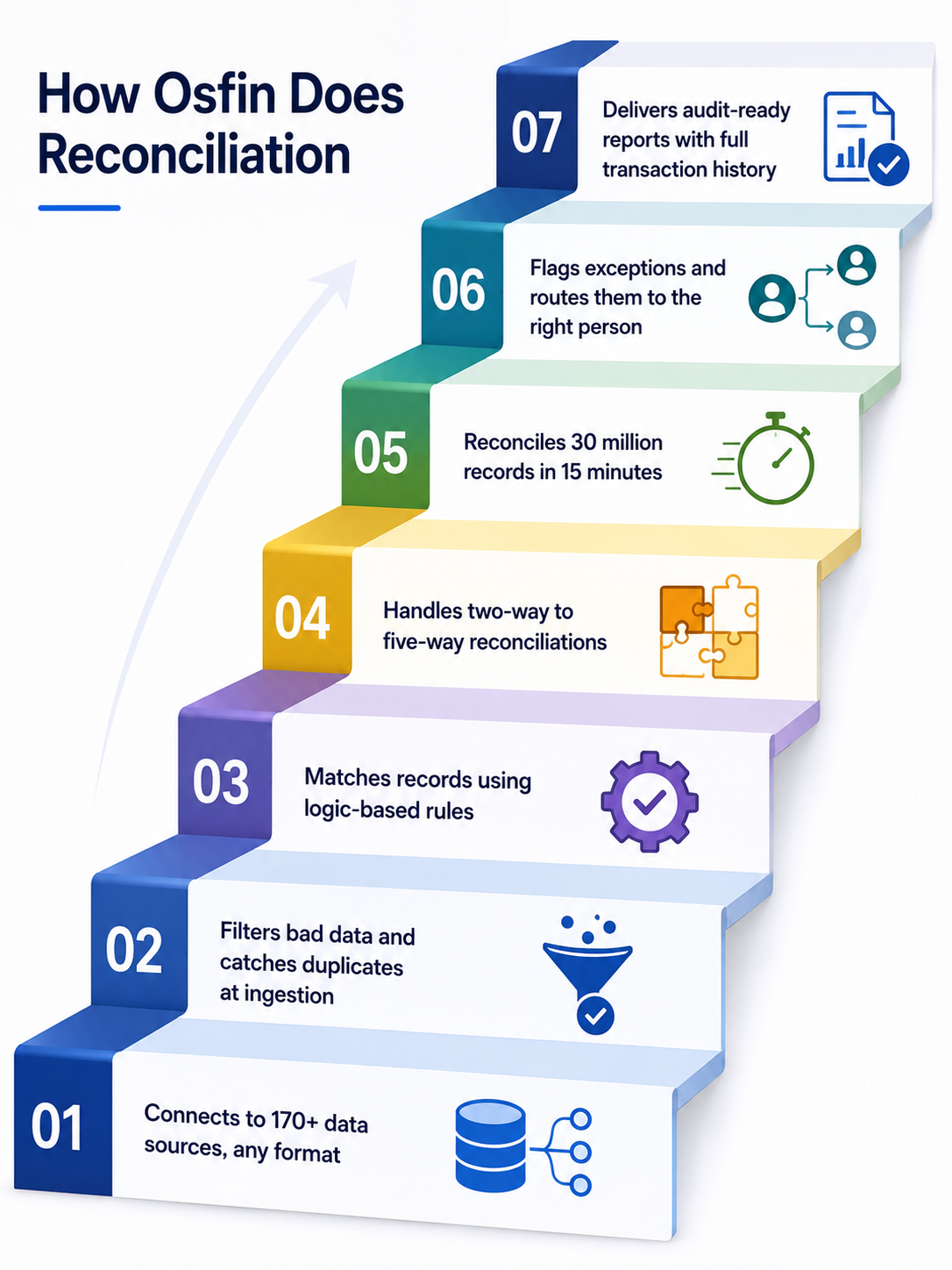
Osfin is a reconciliation automation platform built for finance teams that need speed, accuracy, and control across complex financial operations. It supports the full investigation workflow, from the moment data comes in to the final compliance output.
1. Data Ingestion
Before any investigation can begin, data needs to be clean and complete. Osfin is file-format agnostic, meaning it connects to any data source, regardless of format.
With 170+ integrations, it pulls data from banks, payment gateways, ERPs, and internal systems into one place.
During ingestion, it applies custom deviation tolerances to filter out poor-quality data before it reaches the reconciliation stage.
It also detects duplicates and outliers at the point of entry, so downstream investigation isn't burdened by errors that could have been caught earlier.
2. Reconciliation
Post-ingestion, logic-based matching happens across all records.
Osfin handles many-to-one and one-to-many transactions, as well as complex multi-way reconciliations including two-way, three-way, four-way, and five-way scenarios.
It reconciles 30 million records in 15 minutes and automatically reconciles payment gateway reports with commission, tax, and fee breakdowns.
3. Exception Handling
Each exception is assigned an accurate reason, then routed to the right team member through a ticketing engine.
There are live dashboards that show match status, current exposure, and exception queues in real time, so the team always knows exactly what needs attention and who is handling it.
4. Output and Compliance
Resolved discrepancies leave a detailed audit trail.
You get compliance reports and full transaction history with end-to-end traceability.
Plus, your data is secured with 256-bit encryption, maker-checker workflows, role-based access controls, and two-factor authentication.
{{banner2}}
Best Practices to Investigate Reconciliation Discrepancies
These practices can make your investigation smoother and even enhance the accuracy of your financial statements:
- Reconcile weekly or daily to keep the trail fresh and investigations manageable.
- Every account and open item needs a named owner. Shared responsibility usually means no responsibility.
- Record what happened, why, and how it was fixed. Future investigations and audits depend on it.
- One discrepancy is a mistake. The same discrepancy repeating is a process problem worth fixing at the source.
- Open items without deadlines stay open. Every flagged discrepancy needs an expected closure date.
- A second set of eyes reduces misclassification and strengthens internal controls before an item is closed.
- Investigation quality depends on the people doing it. Regular training on error types and escalation paths keeps standards consistent.
{{banner2.1}}
FAQs
1. What is a reconciliation discrepancy?
It's when two sets of financial records don't match. It could be a missing transaction, a wrong amount, a duplicate entry, or a timing gap between systems.
2. How often should I reconcile?
Weekly or daily reconciliation is ideal. The more frequently you do it, the easier discrepancies are to catch, trace, and fix before they pile up.
3. What's the first step when you find a discrepancy?
Define it clearly first. Know the exact amount, which account it's in, and what period it covers before you start investigating anything further.
4. How does Osfin help with reconciliation discrepancies?
Osfin ingests data from 170+ sources, matches records automatically, flags and routes exceptions to the right team, and delivers audit-ready compliance reports with full transaction traceability.